Politics and Posters
An Exploration of Posters as a Political Medium
Written by Oceana Andries
Oceana Andries is a writer and artist whose work explores the intersection of creativity and community, with a focus on amplifying underrepresented narratives and fostering cross-cultural dialogue.
For this piece, we’ll be exploring posters as a vehicle for political messaging. But first, what are posters? We see them every day and almost everywhere, but what is the medium? The simple answer is that a poster is a public-facing notice intended to persuade an audience: to purchase a product, attend an event, or take an action. The medium is ephemeral and is not intended to be stored or preserved by any means. However, lately, posters have been gaining more institutional recognition as art. For example, Poster House sprang up in Chelsea in 2019 and is the first and only museum in the United States dedicated to posters.
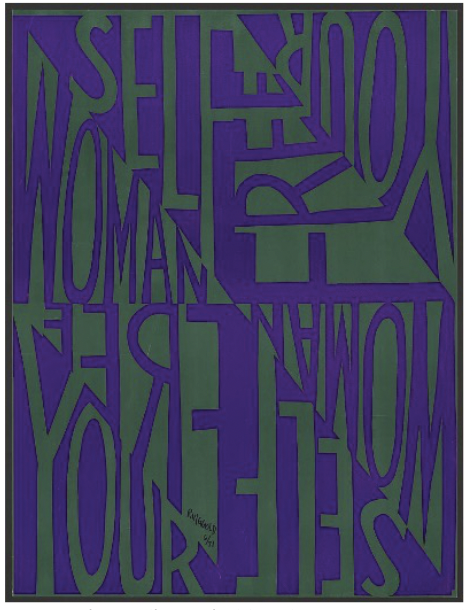
Well-known artists such as Faith Ringgold (b. Harlem, New York; 1930-2024 ) and political organizations such as the Black Panthers used posters to communicate ideas to the broader public. Ringgold was a Black American artist most known for her narrative quilts, but she worked with a range of mediums. “Free Woman, Free Yourself” (1971) is a poster intended to be a call to action. It communicates a message of women’s liberation with bold, contrasting colors. The work was created during the second wave of feminism, when women were establishing feminist organizations and marching for equal rights throughout the country. Ringgold was an avid activist who founded Women Students and Artists for Black Art Liberation (WSABAL) in 1970 and the National Black Feminist Organization in 1974. Both organizations sought to address the unique challenges facing Black women in America. She created work to communicate her political beliefs, address inequality, and empower her community.
The Black Panther Party was a Black Power organization that ran from 1966 to 1982. It was created to address disparities in Black American communities. They created social and educational programs as well as community health clinics. To address their communities, they made a newspaper, The Black Panthers, and advertised through posters. The newspaper informed the public of the party’s activities and expressed their ideology.
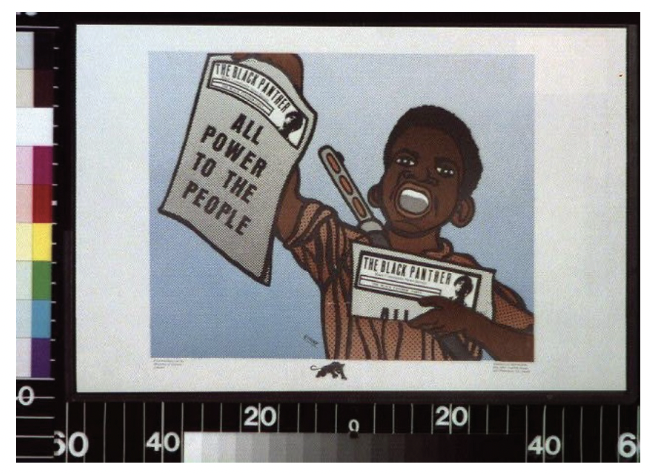
The work above, “The Black Panther: All Power to the People” (1970), was created by Emory Douglas (b. Grand Rapids, MI; 1943), the former Minister of Culture and a revolutionary artist for the Black Panther Party. The poster advertises The Black Panthers’ newspaper, and with its visual cues, the audience is able to quickly establish these facts about the Black Panthers Its target audience is young Black Americans, and the organization’s ideology, encapsulated in the phrase “All power to the people,” is one that advocates for the working class. Through this advert, viewers can quickly understand The Black Panther’s political leanings and mission.
A successful poster can quickly convey its message, as it is typically viewed in passing. Posters are commonly fast to produce and easy to distribute, making them the perfect vehicle to communicate ideas in times of political turmoil, because they respond to the need for urgency and accessibility.
The work of artist Amos Paul Kennedy, Jr. (b. Lafayette, Louisiana; 1948) is the embodiment of these qualities. Through vibrant colors and bold text, Kennedy can quickly catch the eye of those passing and communicate his message. Initially, Kennedy’s style caught my attention when I noticed a print hung above the desk of Denise L. Greene’s, Director of Community Programs and my publisher at The Art Students League of New York. She created it after taking a class with the master printmaker.
Kennedy currently lives and works in Detroit, MI, and regularly teaches letterpress classes. From a very young age, Kennedy has always had an interest in books and letters. He studied calligraphy for several years but later left the craft to pursue a corporate life. His creative passion was reignited in the 1980s (in his 40s) after a visit to Colonial Williamsburg, a Virginia living history museum. There, he was captivated by an 18th-century print shop and book bindery demonstration that led him to leave his nearly two-decade job as an analyst to pursue printmaking studies.
Interestingly enough, though one might assume labels like ‘creative’ and ‘artist’ would be used to describe Kennedy, he resents such exclusionary titles. As he shared in a column with Communication Arts, “I dislike labels because they are designed to exclude people. I print. I am human. We, as humans, have more in common than we have differences. Yet, we use the differences to define us. Why?” Such an adverse attitude to exclusion makes perfect sense with Kennedy’s chosen material and political messaging. Below is his work, “Stop Police Violence/Police Brutality is a Universal Language” (2020).

From the text and the time of the work’s creation, we can surmise that it was created as a response to the murder of George Floyd by Police Officer Derek Chauvin on May 25, 2020. This incident sparked a series of protests, riots, and demonstrations against police brutality. Black Lives Matter, a decentralized political and social movement, held major protests throughout the country. Officer Derek Chauvin was found guilty of second-degree murder, third-degree murder, and manslaughter in state court in 2021 and later pleaded guilty to federal charges for violating George Floyd’s civil rights in 2022. He is currently serving a sentence of over 40 years.

‘I can’t breathe’ were the last words of George Floyd, Eric Garner, Elijah Jovan McClain.According to a 2020 The New York Times article Three Words. 70 Cases. The Tragic History of ‘I Can’t Breathe’–the phrase has been spoken by more than 70 people who died in police custody. Kennedy lays the phrase on top of various imagery of police, Brown Chapel AME Church, and Black Americans. The Brown Chapel AME Church played a pivotal role in the Selma, Alabama marches that helped lead to the passage of the 1965 Voting Rights Act. This historically important building, rendered with imagery of police brutality and the phrase ‘I can’t breathe’, connects the past with contemporary movements to showcase a lineage of activism against oppression.
Posters can be artifacts of urgency, persuasion, and belief; they are thin sheets of paper that can hold the weight of entire movements. Artists have used them to empower their communities and spark meaningful conversations. Although they are most commonly used for commercial purposes, when the medium is used by a revolutionary spirit with a creative eye, the results can ripple through the public consciousness and create waves of change.