Left, Right, and Straight
Written by Daniel Onofreichuk-Demyan
Daniel Onofreichuk-Demyan is a multidisciplinary artist training in music and visual arts. He began his artistic studies at a young age and continued a strong practice in both fields throughout high school. Daniel began taking classes at the League and soon after became a seeds scholar. He has studied painting with Garin Baker and Ricky Mujica. He is seeking to complete his BFA in Fine Arts and continue his career forward in the New York City area.
Coming from a family of musicians, music and art were essential parts of daily life and culture. Performing, making my own work and exploring the arts is a lifestyle my parents fostered in my brother and me since youth. As far as I can remember I have been painting, drawing and playing the piano. Naturally when it came to college I decided to pursue the field that is a foundation of my life in pursuit that one day I can return to the community that I found my place in.
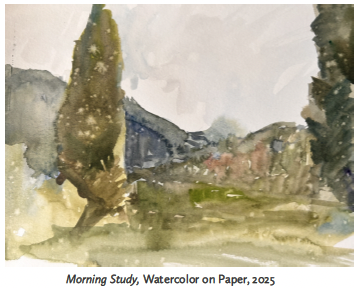
My time in a music conservatory in Florence, Italy was filled with days of practice, rigorous classes and performances. Amid the chaos of conservatory I was also learning a new language and navigating a new culture. Despite all the moving parts, drawing and painting continued to be a core part of my daily life. My day wouldn’t really feel complete without it—creating, reflecting and externalizing my experiences. The need to create wasn’t from impulse but from a long time practice of both art and music—the two became my right and left hand, functioning in conjunction to create a coherent life for me.
The depth of exposure to history, art and music was beyond enough for a lifetime. The religious masterpieces in the Uffizi museum or the voices of opera students rehearsing Puccini’s “Turandot” in the halls of the school inspired me to engage with the present and give my attention to each moment. Living presently made me interested in the people I hadn’t noticed and the places I overlooked. Shostakovich’s 8th symphony gives a vivid insight into his personal life and reflects the experience of the people during the Stalingrad siege. Shostakovich’s depiction of the tragedy was not only to record the present but to offer an insight into the future. It would have been reasonable if Shostkoviech would have shut himself away during the time of crisis. Instead he responded to the present by creating work sensitive to his community. On a surface level, his work may have seemed like propaganda. In fact, it shed light on the historically neglected events in Stalingrad. This is the kind of authenticity I aspire to reflect in my work—embracing the present with the new interpretation of the future.
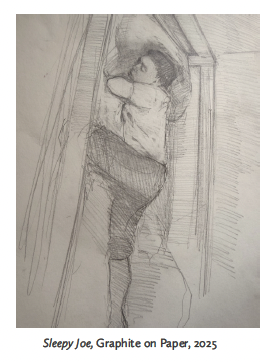
Performance or creation requires my vulnerability to become the bridge that allows the audience to engage. As I work in the visual medium the awareness of the people who will engage with my work reflects from my musical training. It compels me to create work outside of my own narrow perspective and find a universal feeling that can be understood innately. The visual arts specifically have the primal ability to communicate across time, language and culture. It’s what connects us with our ancestors and generations to come.
While I take a gap year to focus on my education in the arts, it excites me to study at the League with its important history. Being part of such a community gives a sense of responsibility towards the visual arts. While learning from instructors technical aspects of painting or drawing the discussion to create authentic human connection is often present. These discussions open my practice and make the time I spend practicing meaningful. In a time of dismantled human connections, continuing the traditions and explorations of visual art become vital. While I continue studying at the League and in higher education, I aspire to continue the League’s impact and mission.