Everything is Connected to Everything Else
by Regina Furtek
Pondering the question of what most shaped my life journey and the important role of art-making in it, it’s hard to escape the influence of family lineage, especially of my mother.
Her example showed me how to be and how not to be. My mother was a child of World War II, raised in a family of subsistence farmers in rural Poland, close to the border of Ukraine. Hers was a childhood marked by extreme deprivation, scarcity, and many unknowns. When I would ask her for stories from her life in Poland, she simply stated there was nothing good about it. I came to understand that although my mother survived, she was not emotionally or mentally well. Her primary emotions expressed were anger, fear, and sadness. Today we recognize this condition as PTSD. But, at that time her imbalance was misunderstood and undiagnosed.
Looking back at my young self, I see that I was a highly sensitive kid or what is now labeled an empath, often very aware of my mother’s or others’ feelings. I was very curious, and wanted to understand why she was that way, how the mind works, and how I could help her.
I grew up as the youngest of three sisters in an insular blue-collar home in a Polish American immigrant neighborhood of Philadelphia. My mother had frequent emotional outbursts due to her unprocessed trauma. She created an atmosphere of yelling, conflicts and at times threats of violence. I learned to cope with this by escaping to my bedroom where I couldlisten to music, draw and decorate my room with the results. My other coping mechanism was walking to the library and exploring the books. The quiet space of the library felt like a sanctuary, and the books were portals into other worlds of adventure and wisdom. I was hungry for knowledge and inspiration. Although my mother could be quite clever, neither of our parents received an education beyond eighth grade. She was a hard worker and held a job cleaning offices until she was 77 years old. It became clear to me early on that to attain a better and more expansive life, the American Dream, I needed higher education and a career.
I had no idea what I wanted to be when I grew up. But when I was around 12 my aunt gave me a surprising gift, a pocket camera. It filled me with great curiosity, excitement, and delight. I was utterly fascinated by looking through the viewfinder and forming compositions. A love of photography and image making began to grow. At this age I had never stepped foot into a museum. Entering high school, my world expanded. As a freshman, I discovered the Art Studio! I remember standing in the doorway and wondering, “What is this space?” I knew immediately in my heart that I wanted to inhabit it.
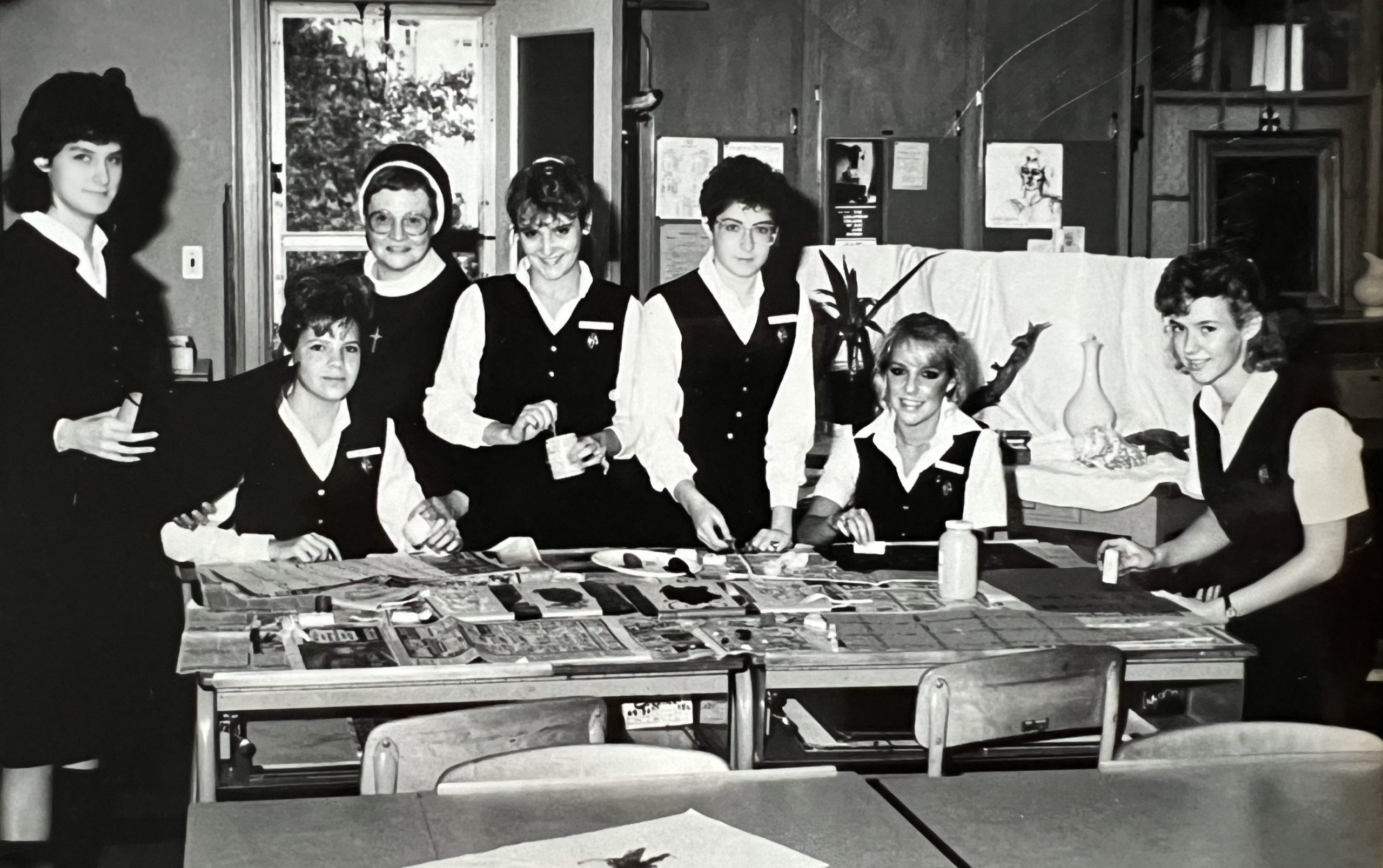
After completing the required intro to art class, I chose art every year as my elective despite my mom’s disapproval. As I learned about art history from projected slides, I developed a deep longing to travel and see the world’s masterpieces, especially in Italy. They weren’t simply pictures to me. They were mind-blowing reflections of the ultimate achievement of human consciousness. My first art teacher was a nun named Sr Regis, whom I both feared and admired. She gave us a classic self-portrait assignment. This simple yet profound exercise opened the door to self-inquiry. I took classes with her for four years. I felt seen by her and she helped me to see myself. Upon high school graduation she recognized me publicly by giving me the class art award. Sr Regis told me later it wasn’t because I was the most skilled artist. She chose me because she said I was the most determined student and had made the most progress. I burst into tears and she hugged me. It taught me that the qualities of determination and perseverance are important and useful in creating a meaningful life.
Never having attended high school or college, my parents weren’t capable of guiding me on. I really was not sure what to choose as a major. I simply knew that I wanted to go to college and needed to support myself. It was Sr Regis who suggested studying textile design as my next step. I followed her advice. In college I worked waiting tables to pay for tuition that wasn’t covered by grants. My sisters and I shared an apartment after leaving our parents’ home. My eldest sister was my role model, always the diligent student, high achiever, and loving supportive sister. She lit the torch and helped show me the way.
Upon college graduation I grew more and more depressed. I knew how to succeed in school but didn’t know how to find a job and become an adult. I found my early 20s quite difficult to navigate. Gradually, I took the steps, researched textile companies, sent out resumes, went on interviews, and received a few job offers. I took the plunge, accepted a textile computer aided design (CAD) offer that felt best at the time, and began my career. At 23, two years after I started this job, my father died. It was a life altering event. Now I knew I had become an adult.
After four years at that first job, full of hope and fear, I decided to seek opportunities to advance by relocating to NYC. My job responsibilities expanded. I was eager to learn, and I worked hard with many talented colleagues and over time I earned a higher salary and received work travel opportunities. I flew many times overseas including to Italy, saw Michelangelo’s David, the Sistine Chapel, the Birth of Venus and much more of the Italian art I had been drawn to as a child. It felt like the universe was giving me a series of green lights, and I kept on driving—until the economic crash of 2008. Like many people, I lost my job. Work had become my coping mechanism and sense of security. I felt devastated.
Yet, after processing the shock, I also appreciated the sense of space that seemed to open up. While unemployed, I turned to art again. I had been working for 19 years and had just moved to the Bedford Stuyvesant area of Brooklyn. I took many long walks with my camera and shot street photography. The neighborhood had a different welcoming energy generated by strong spiritual communities and social activism. There were remnants of the civil rights struggle, murals of leaders such as Martin Luther King Jr., Malcolm X, and Shirley Chisholm which I found inspiring. The city of Philadelphia was quite segregated during my childhood. So, this was my first experience living in a diverse Black American community. It expanded my awareness of white privilege and made visible aspects of racism and inequality I had not noticed before.
When I started working again, I became Design Director, a coveted role and title. Still, the economy and business was slow to recover. After two years, with the business still slow, I was let go. I felt this was a lesson that my self-worth did not need to be linked to my job or my performance. After a few months I was offered another textile design job, which lasted five years. Then the owner sold the business to a larger company. The new ownership eventually let most of the employees go, including me. I shifted to free-lance, a work model I had not yet tried. After completing a few projects, the Covid-19 pandemic hit. My elderly mother caught it and was seriously ill, hospitalized. I had time to support her as I wasn’t working.
The pandemic gave me time and space to re-think my life. Losing my job three times might be a message from the universe to shift course. I had had a 27-year career in an industry that was contracting due to globalization. What did I wish to explore? I had a long-term yoga practice and wondered about enrolling in a training certification. Yoga had been helpful in dealing with stressful times such as my job losses. I also had an interest in sound healing after experiencing a gong bath years ago. I followed my intuition and enrolled in programs in both areas, which turned out to be a smart self-care decision. This gave me access to two supportive communities throughout the pandemic. If you don’t have your health and well-being, what do you have? My mom slowly recovered.
When the pandemic began to subside, I needed to go get another job. But I didn’t want to pursue the same type of industry position. Based on a friend’s suggestion, I decided to try modeling at the Art Students League. I can only explain this shift as “during my mid-life crisis I went back to Art School”. This was one of the hardest things I have ever done. I’m an introverted-librarian type, not a let’s-get-nude-on-a-stage type. But I discovered so much about myself while posing. Most importantly, I faced my fear and learned that I can actually do things I do not feel capable of doing. I accepted myself as good enough to step on a stage and simply be me. I started taking painting classes. My life came full circle and brought me back to spend time in the Art Studio.
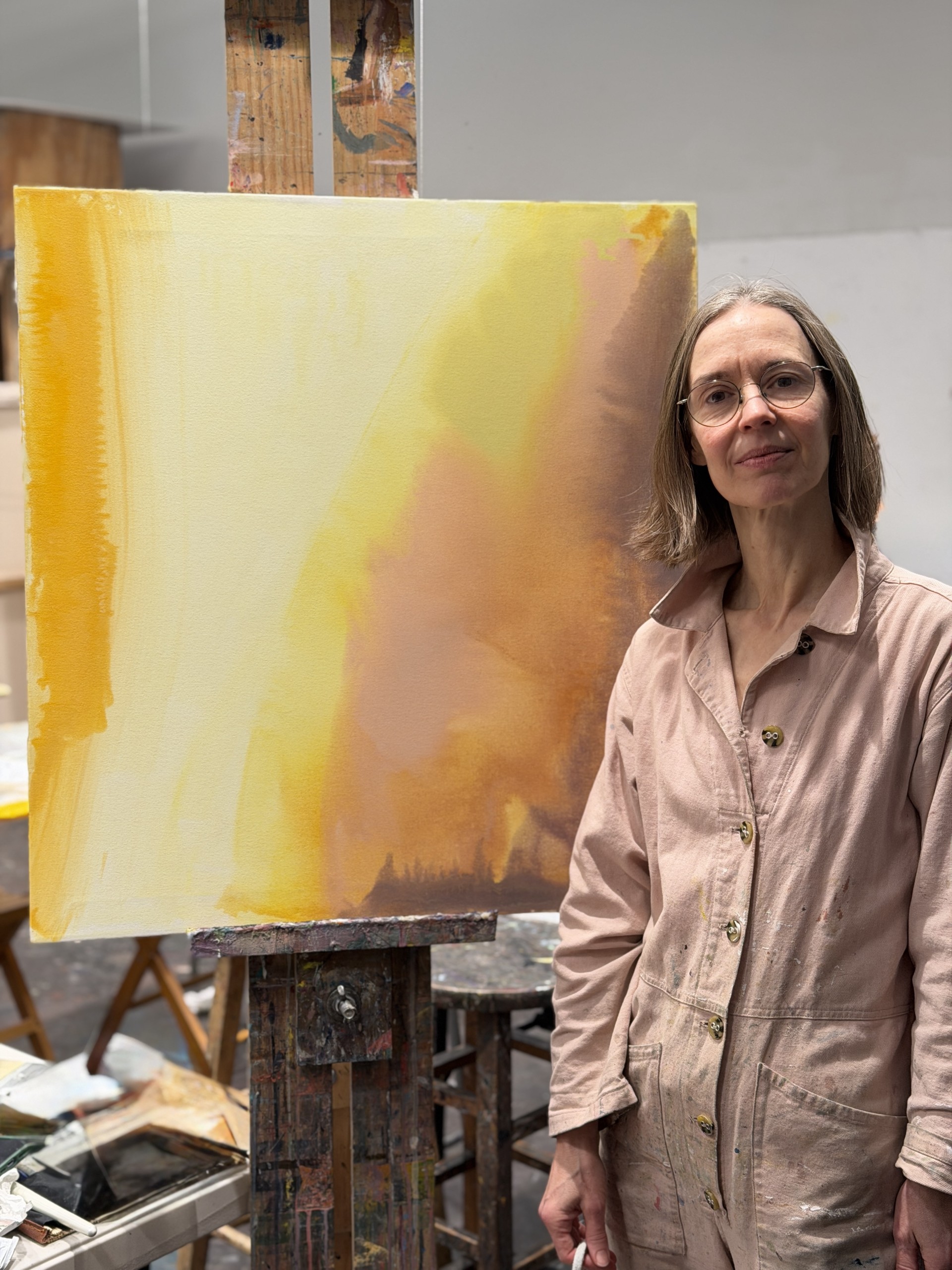
It became clear to me that if I wanted to progress as a painter, I would need to devote more of my energy to a consistent painting practice and less time to modeling. I wasn’t earning much from the modeling work and believed that I could eventually earn the same or more from selling my own work. My primary teacher at the Art Students League has been Jill Nathanson. With her, I have studied abstract painting with a focus on color and emotional impact, color field painting. My textile development work was specifically in home furnishings and interiors. A significant part of that job was understanding and creating living color environments.
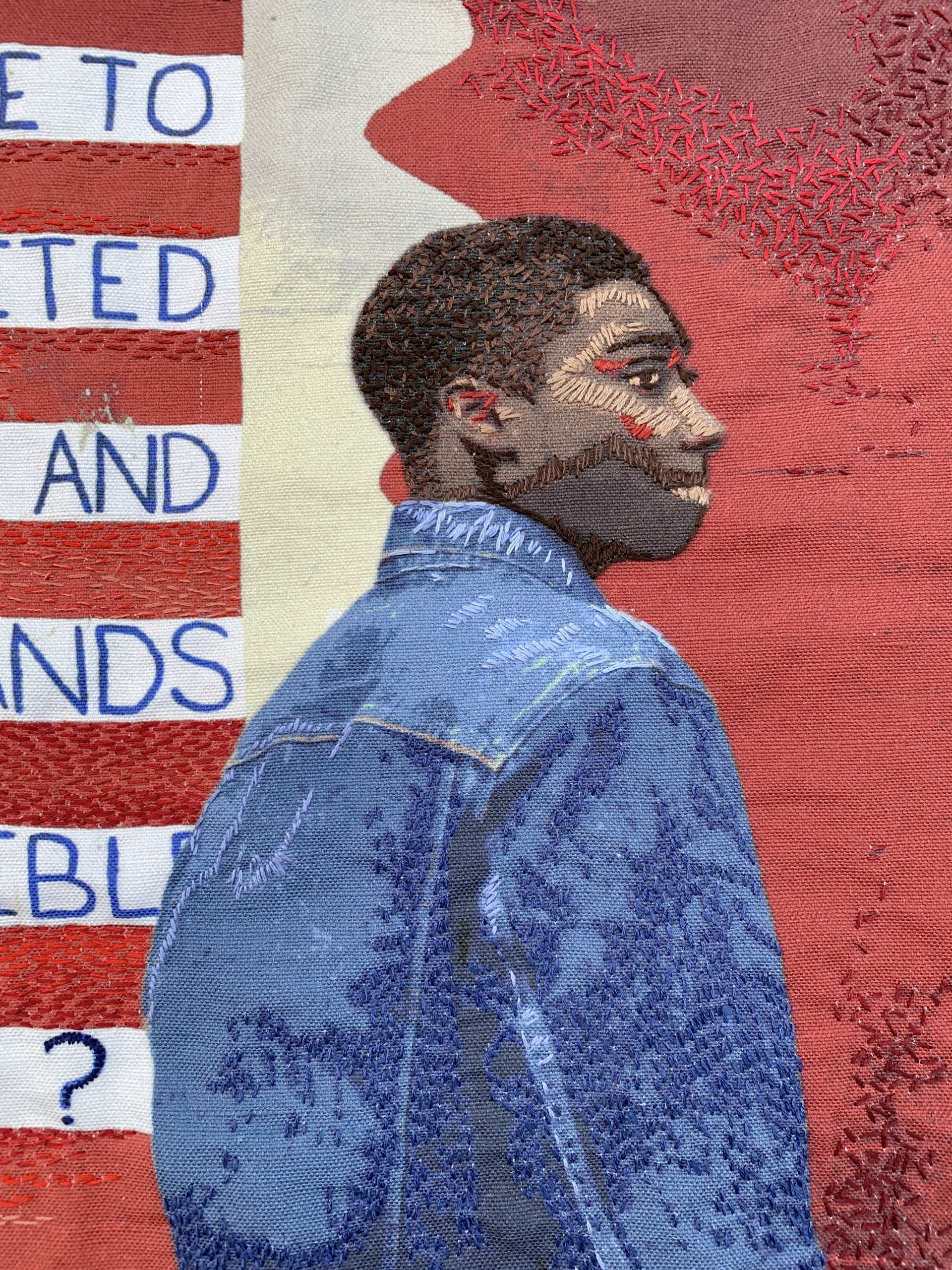
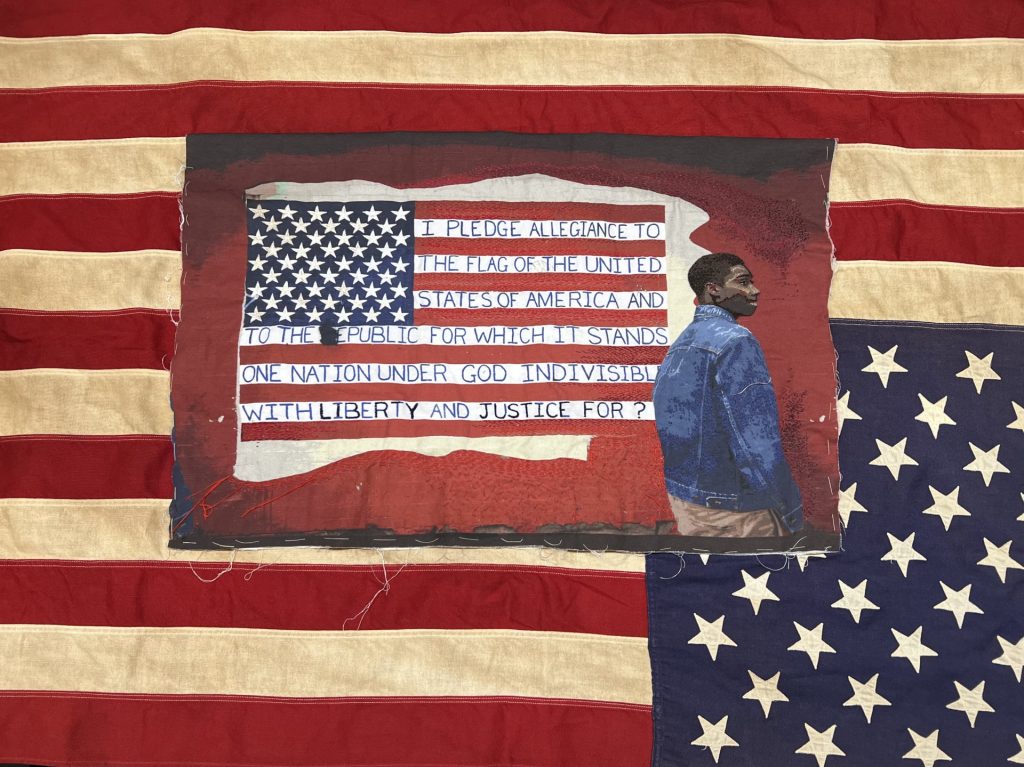
Missing doing creative textile work and wanting to combine my photography, I recently began working on a piece inspired by a street photo I took of a young man of color walking past a painted American flag. After digitally manipulating the photo, I had it printed on fabric and began highlighting elements of it with stitching. The spots of red on his face represent bloodshed, the denim jacket he wears is an all- American symbol of clothing, the stars are stitched in various shades of white calling into question how one feels about whiteness. The reality is our society still lives with injustice, racism, and prejudice in different forms. The legacy traumas of slavery, war, and abuse have been passed down to each generation. At times subconsciously. I created this piece to shine a light, and call attention to this issue. Because everyone’s life and traumas need to be witnessed in order to heal and recover.
You can view more of Regina’s art online @reginafurtek on Instagram