Religious Symbols of the African Diaspora in Visual Arts
Exhibitions of Mestre Didi and Renée Stout
By Oceana Andries
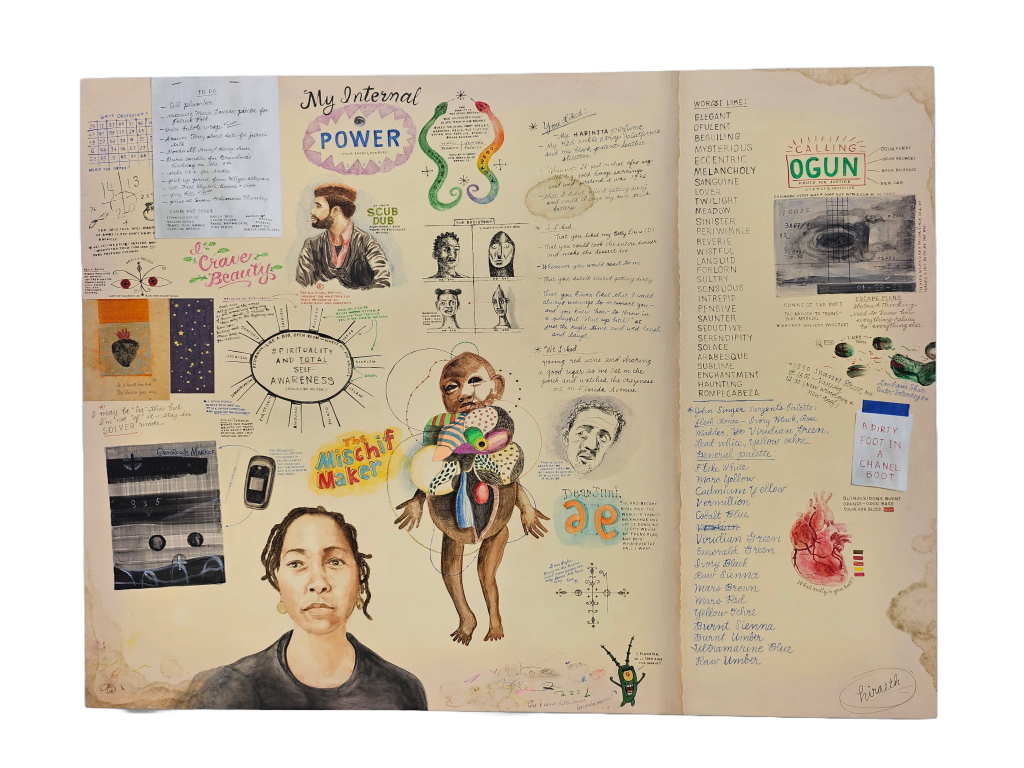
Acrylic and collage on panel, 48 × 60 in.
Photo taken by Oceana Andries
Recently, I’ve noticed a trend in artists of the African diaspora representing Afro-diasporic religions through paintings and sculptures. Artists working in this way aren’t new, but cultural institutions have begun to spotlight artists engaged with the visual spiritual language. Two instances of this stood out to me. The first was when I visited The Museum Mile festival, an annual event where museums along Fifth Avenue are open free to the public with music and food (similar to a big block party), and I happened upon Mestre Didi: Spiritual Form at El Museo del Barrio, featuring work by the late Mestre Didi. The second instance was when a friend wanted to meet at Marc Strauss Gallery to see Truth-telling by Renée Stout. These artists work under different religious sects, but they share a commonality: their beliefs originate from a mixture of Catholicism and West African Yoruba spiritual traditions. Mestre Didi showcases Candomblé, while Stout presents Hoodoo.
As this Afro-diasporic religions are now being introduced into the art market, I believe it’s important to explore their visual symbolism to understand their significance to these communities. Before we get into these artists and exhibitions, here’s some important background information on the origin of these religious sects: through syncretization–the blend of different beliefs or cultures–enslaved populations found ways to practice their Indigenous religion by concealing their beliefs through numerous methods, one example being under the guise of Catholicism. This religious mixture gave birth to many religious sects across the Atlantic slave trade. As a result, these traditions are practiced today primarily in the Caribbean, Brazil, and the Southern United States. With that, let’s begin to explore the practices of Mestre Didi and Renée Stout to understand the religious symbols of the African diaspora in visual arts.
Mestre Didi (b. Salvador, Bahia, Brazil; 1917-2013) was a sculptor; within his work is the collision of artistic and spiritual values. Mestre Didi: Spiritual Form featured over 30 of his sculptures and presented a retrospective of his spiritual and artistic legacy. This show was my introduction to the artist and his work. The pieces were created with palm ribs, painted leather strips, cowrie shells, and beads, materials uncommon in the Western canon. The palm ribs, which resemble wood, are the base of each of his sculptures. As I walked through the exhibition, I realized its spiritual meaning because the patterns and colors Mestre Didi utilized resembled the symbols of Orishas. The Orishas are deities of Yoruba traditions. The sculpture “Opa Aiye Orum – Cetro de Oxalá [Oxalá’s scepter],” 1969, tipped me off to its spiritual connections. I was able to identify the symbols of Oxalá, a central figure in African diasporic religions. He is often known as the creator of Earth, who molded humans from clay. This sculpture featured an abundance of white, which is symbolic of the deity’s calm nature. The bird perched on top of the scepter appears to be a white dove, a symbol meant to showcase Oxalá’s peaceful attributes. I later read the wall texts, and my suspicions were confirmed by its title. As I continued to explore the exhibition, I discovered each work was laden with religious meanings.
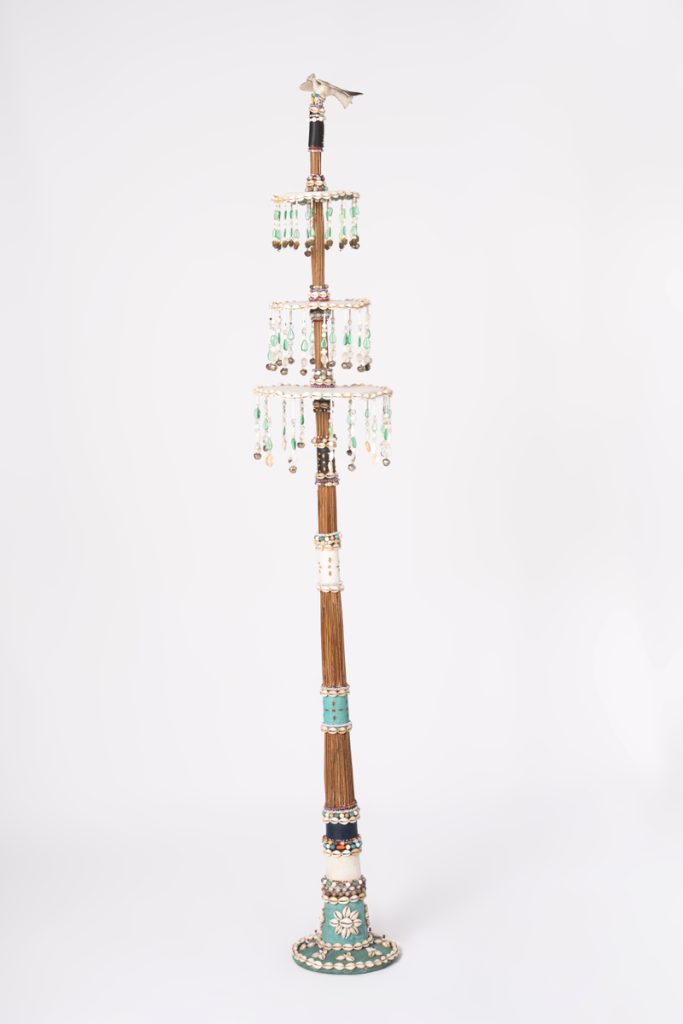
Oxalá [Oxalá’s scepter], 1969. Palm ribs,
painted leather, shells, and beads.
Instituto Paz Collection.
Image courtesy of Inaicyra Falcão and
Instituto Paz. Photo by Icaro Moreno.
I delved further into the reading materials, after a few laps around the exhibit, and discovered Mester Didi was born into Candomblé. He later became a priest in a terreiros, a place of worship, called Ilê Axé Opô Afonjá. A terreiros is a central hub for a community to conduct ceremonies for worship. He spent decades creating consecrated ritual objects in Ilê Axé Opô Afonjá in service of his community and deities. Though none of the sculptures featured in the exhibition are consecrated, they’re imbued with spiritual symbolism and act as a conduit between Mestre Didi, his spiritual community, and the viewers. Although I happened upon this exhibit by chance, I gained insight into an Afro-diasporic religion that was previously unfamiliar to me. Candomblé is a lesser known sect in the States, and primarily practiced in Brazil. Through this exhibit, Mestre Didi plays on what viewers know and introduces them to what they don’t.
Renée Stout (b. Junction City, Kansas; 1958-) is a multidisciplinary artist. Her art engages viewers with Hoodoo and Voodoo. Unlike Mestre Didi’s work, the meaning in Stout’s practice was much more apparent to me upon initial glance at Truth-telling. I found Stout’s work to be extremely lively. Through sculptures and paintings, Stout guides viewers through a journal-esque practice where her writings become an integral part of the visuals on the canvas as she engages with the African diaspora, religion, and art history.
Here’s some background on the sects she engages with: Hoodoo is a form of folk magic born through syncretism that represents a less-formalized participation with African spirituality than Voodoo. Its focus is on practical improvement in the user’s life through the use of power objects, symbols, and rituals. Voodoo is an organized religion that requires initiation and integration into one’s life. Though they have many similarities and often share practices, the difference is that Voodoo has a more communal aspect and a higher level of commitment.
The piece in the show that first caught my eye was “Sketches on Old Paper,” 2025. The work looks as though someone scanned an open notebook, but didn’t crop it very well, so we see the entirety of the left page, with the right side cut off. My initial reaction to the work was a bit of confusion; the writing and characters float on its surface with no clear connection. It appears that Stout is working through her thoughts without a clear narrative, as the presentation is disjointed. But, as my eyes traveled across the canvas, Stout’s work began to unfurl its meaning. I was able to connect Orisha’s name and symbols to her notes, which helped me understand her work.
“Legba” is written at the bottom of the canvas. Legba is a central spirit within the Orishas. He acts as a messenger between the spiritual and physical realms. As he oversees the ‘roads,’ in both a literal and figurative sense, he can see fates. Though he warns against a hard path, he allows devotees to choose their own, and often they choose a turbulent fate. Stout’s message to him on the canvas encapsulates these qualities: “Dear Legba, Bring on the lessons since some people can only learn the hard way. Love R.”
Stout further amplifies Legba’s qualities directly under “R.s” message, Plankton, the popular character from Spongebob Squarepants, is painted alongside small child-like scribbles. Legba is known to possess youthful energy and a mischievous nature. The markings, being at the bottom edge of the canvas, create the impression that he drew on it himself due to his child-like attributes
Truth-telling creates an experience where visitors can casually enjoy a visually captivating yet cryptic experience. But those with insight into the symbolism of African diasporic religions can engage in a layered visual discussion of Hoodoo, Voodoo, its objects, and the spirits its devotees work with.
Both of these exhibitions represent the saying ‘hidden in plain sight,’ a term that can be applied across African spirituality, from the origins of the religion’s syncretism to contemporary artists engaging with its visual language. When presented to an unknowledgeable viewer, they appear as beautiful yet uncommon with materials and characters unseen in the Western canon. But to someone with proximity to an Afro-diasporic religion, a language unfolds. Artists are showcasing these religions and launching the creative canon in a new direction, one that is no longer hidden. Across mediums, countries, and religious sects, the symbolisms held in Afro-diasporic religions are being ushered into the visual consciousness of today. These summer months have been filled with artists and their various creative expressions. It’s exciting to witness the art market’s introduction to the different visual forms of African diasporic religions.