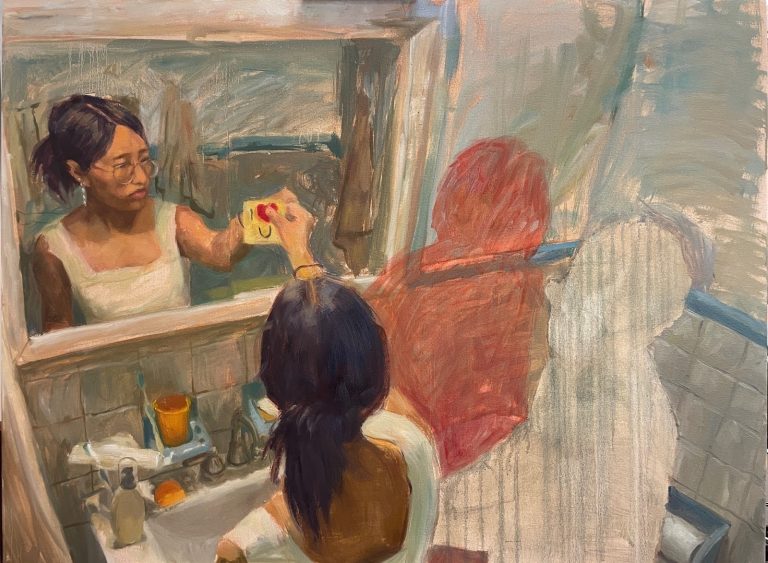
Artist Xin Song is part of Seeds of the League’s Advisory Board.
Xin Song is what New York is all about. The Beijing born, Brooklyn-based artist creates intricately detailed papercut compositions that appear throughout the city, from galleries to train stations. In a world that moves so rapidly that we forget where we come from and what we are made of, Song’s work poses us a unique challenge: to recognize the memory in material, and to look closer at the details.
I interview Song after the opening of her recent solo survey show, “Chaos and Belief” at Artego Gallery. We talk in her studio, located in the Elizabeth Foundation for the Arts (EFA) studio building, an organization where Song has been a longtime member. In one corner are copies of National Geographic magazine stacked to the ceiling. Her collages, prints, and various pieces from over the years dot the surfaces and walls. There is even a poster she designed for the MTA’s “Poetry in Motion” series. The room vibrates with colorful paper and fabric. We speak seated at a large table covered in a graphing pad, where she makes her cuts.
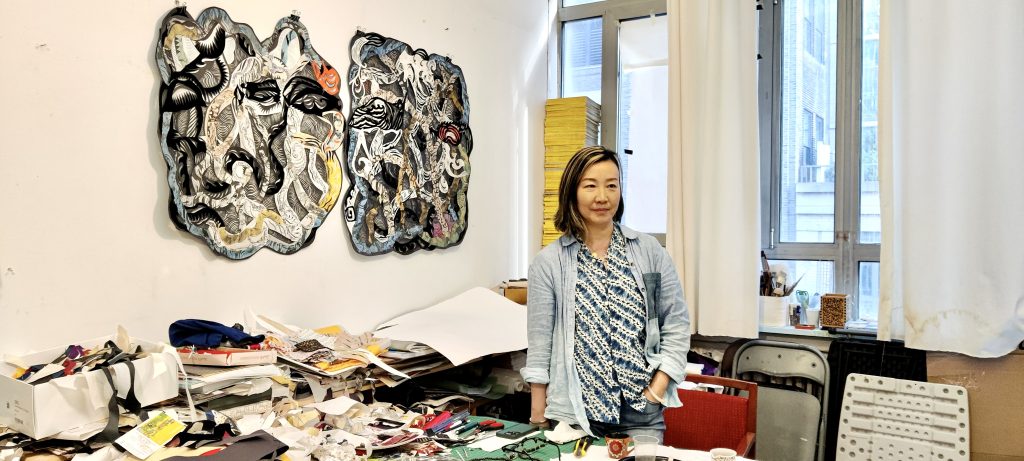
Song employs the technique of papercutting, a traditional Chinese art form. Before I speak to Song, my mother—who grew up in the Shandong province of China—teaches me the Chinese words for papercutting: 剪紙 “jianzhi.” Papercutting emerged around the 600 AD, and has been passed down for centuries. The technique involves using scissors or knives to cut detailed shapes into paper. Out of this positive and negative space emerge forms and symbols like animals, flowers, and Chinese characters. Traditional papercuts primarily serve a decorative function, used to adorn walls, windows, and doorways.
Papercutting falls into the category of folk art, loosely defined as art that is handmade, decorative/for use, and a product of cultural expression for a specific community. Folk art, with its roots in many BIPOC communities, is often overlooked for “fine art,” which is more durable and Western.
Song’s practice goes back to her experiences learning paper cutting as a folk art, though her work itself is distinctly contemporary. While studying at the Central Academy of Fine Art in Beijing, she spent time in the Chinese countryside, researching paper cutting as a folk art practiced by farmers. Even within China, Song explains to me, the style of papercuts vary in detail and pattern by region. Form is influenced by the terrain: for example, in the Northwest of China, the patterns are more open, mirroring the wide plains that make up the landscape.
Here in NYC, Song’s work reflects her environment. A close look at her collages reveals photos she took of street scenes, classrooms, neighborhood shops, and architectural features. She says: “I just take events I bump into like Occupy Wall Street. So many protests, so many things happening, activities, Halloween and the parades… I feel it’s kind of a moment you should remember.”
She also uses photos she finds in magazines. This practice began around 2004, when she first came across discarded magazines such as National Geographic, and architecture and fashion magazines on the street. She was drawn to these images because of their high quality and curated nature, which offered a window into people’s concerns from different time periods. She describes how “in some 70s/80s magazines…people were already talking about nature, environment, global warming.” Song notes that magazines are a disappearing medium, with the turn to digital, and we bemoan together the loss of print culture.
Against this backdrop, Song’s work takes on an archival quality. Her materials hold the memory of past mediums and cultural moments. This is also seen in her recent foray into quilting. “In search of lost time: series,” a standout piece in her recent show, is a quilt that spans an entire wall. It is composed of 71 small panels, each of which contain their own playful energy and aesthetic realm.
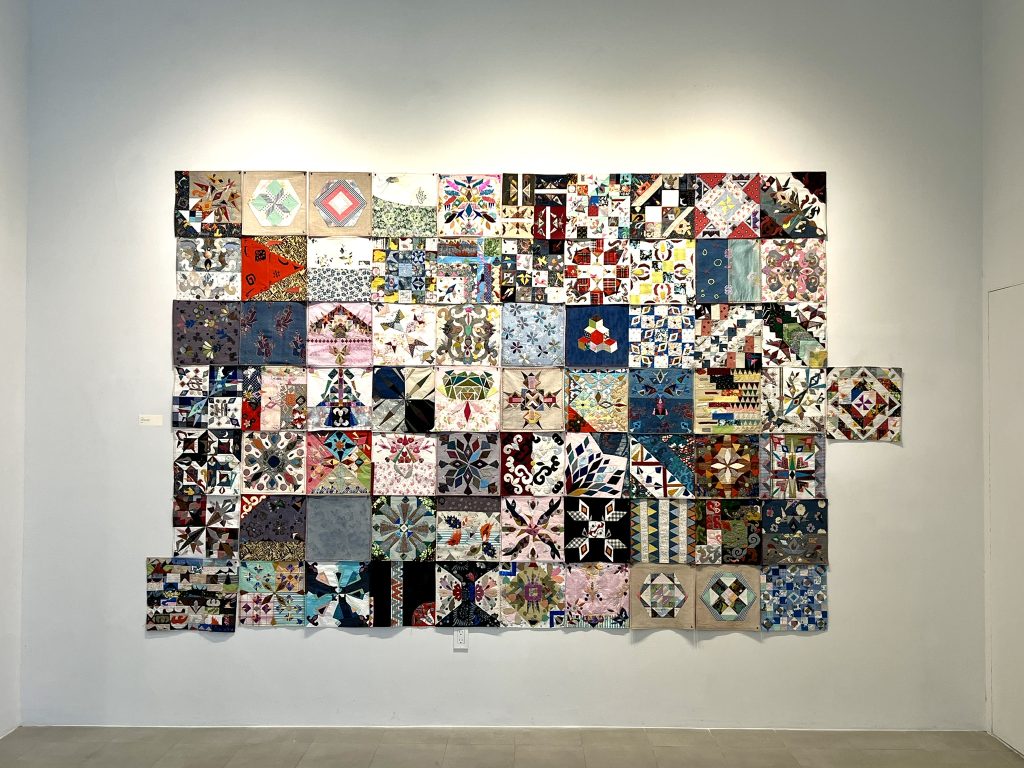
Song started quilting at home during the pandemic, when she was unable to go into the studio. Her familiarity with the material had begun developing since she worked in the textile industry years earlier. To quilt, she uses fabric her mother had been collecting for years but never found use for. Of the fabric she says: “all the pieces have the memory.” She also shows me a series she has recently begun, taking old handkerchiefs and sewing in energetic shapes and details. One is from a restaurant in China, another from Disney World. The work breathes new life into an object that has almost disappeared.
“Not a lot of people pay attention to the details.”
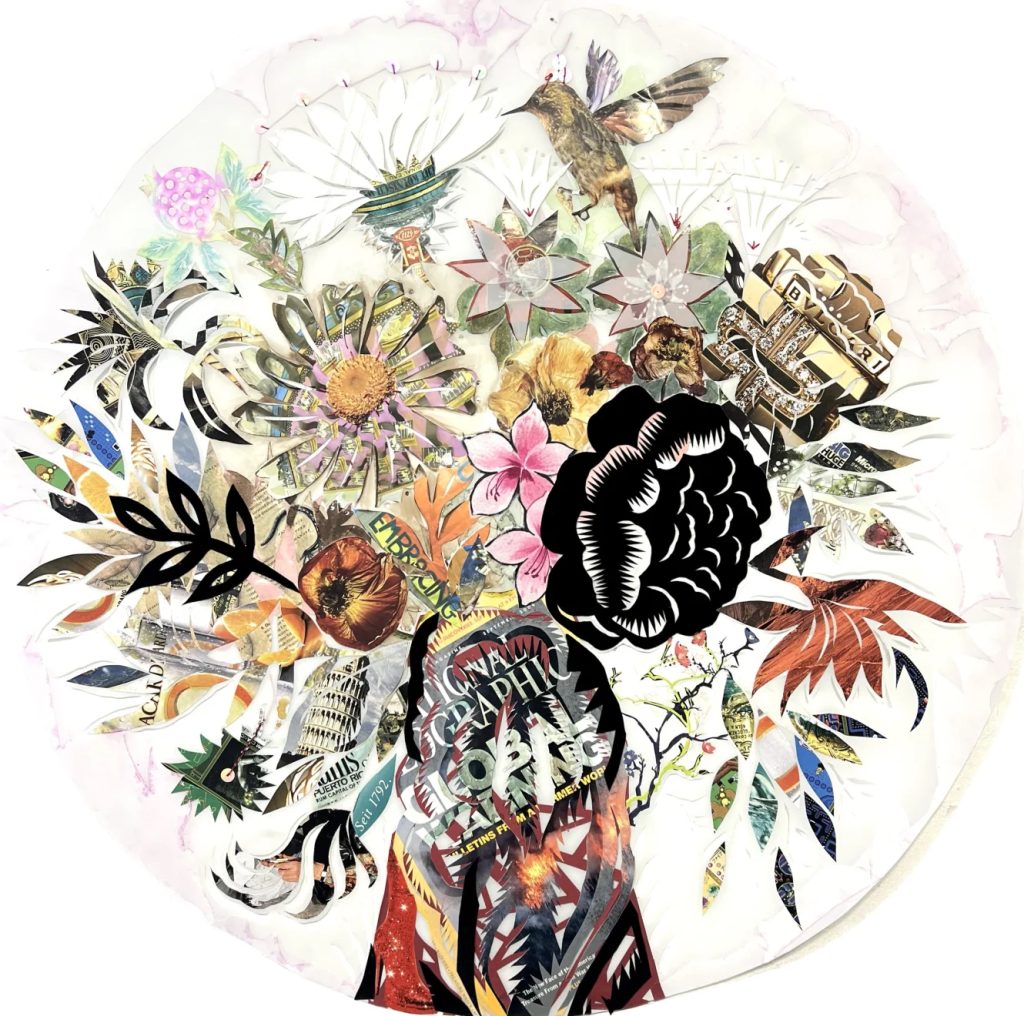
Song’s work is a puzzle of material history and content. Take another piece from her recent show, the “Life in Full Bloom” series. The piece is one in a series of twenty works. When I see the piece from a distance, the silhouette is a bursting, colorful garden. Upon closer look, I notice a theme between the images: statistics about immigration quotas, photos of refugee camps, protests, farmers, and vibrant displays of diverse cultures. The connections form immediately: global immigration flows where immigrants are both demonized and yet critical to maintain systems like agriculture and a community’s diversity. I share my observations with Song, to which she is excited: “not a lot of people pay attention to the details.” Her papercuts demand that we take in an image slowly, closely, instead of at the rapid and fleeting pace that we so often encounter now. Looking at a piece by Song takes a heightened degree of attention, one akin to the close, hand-made focus that the creation of her work requires.
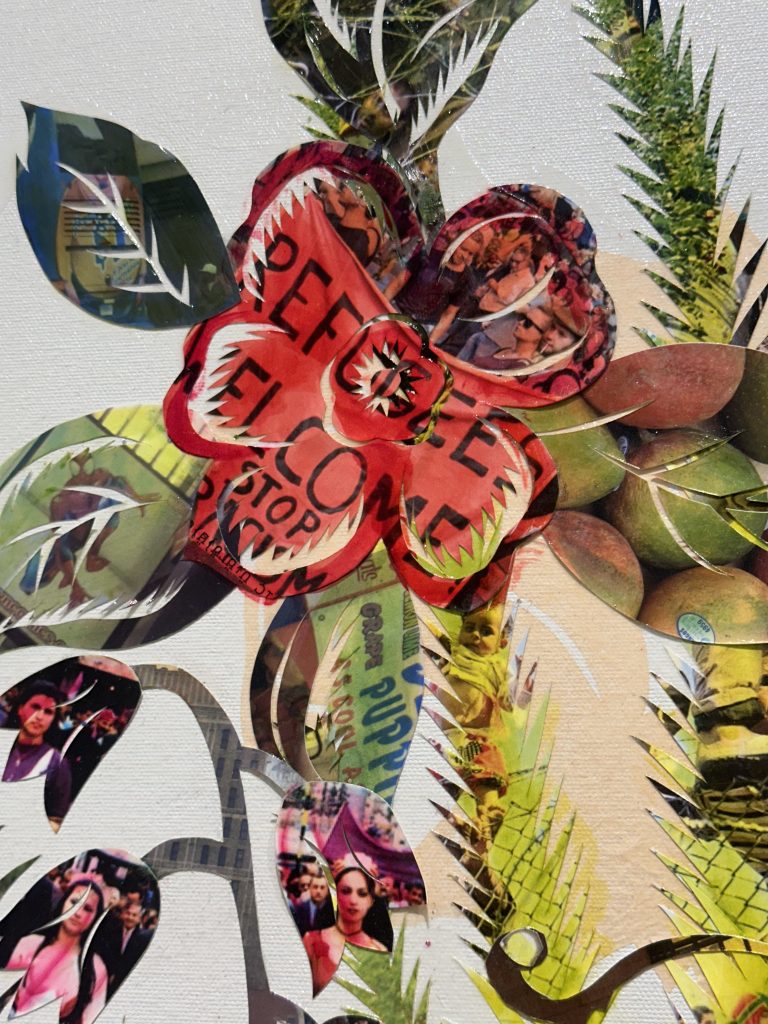
There is even thematic significance to the floral silhouettes of the piece. Song describes visiting the High Line and always seeing flowers blooming. She researched the gardens there and found the flowers were specially selected for their durability to the elements. Learning this, Song connected it to the character of the city: “it’s just like a New Yorker, I feel, oh my God, that’s our temperament.” She took photos of those flowers, which form the outline of the pieces in this series.
Song’s love for the NYC community also shines through in her public art, which allows her to connect with a wide audience: “Public artwork belongs to the people. They see it, they inspire it, they look at it. They may not get it right away. But later on, they will feel it. That’s why I do it, to participate with the community.” Her work “Tree of Life” is permanently installed in the Bay Parkway train station. To create it, she took images from all over that South Brooklyn neighborhood, which is composed primarily of immigrants from Russian, Middle Eastern, Eastern European Jewish, Chinese, and Mexican descent. The images are cut and collaged together to form the larger silhouette of a tree. “It became a tree of life. It’s just like myself. I come from another country. I have roots here, I grow.”
Song’s work showcases the bursting breadth of New York City’s diversity. It archives another truth: that we are a city, and nation of immigrants. This fact holds critical weight at a time when xenophobia runs rampant across the country. In Song’s resilient, blooming forms, and photographic choice, is a celebration of our community and our history.

The power of connection is at the heart of Song’s work.
Song’s career has progressed through sustained hard work. She built her network by applying for shows, joining groups such as the Asian American Women’s Alliance, and studying at the Art Students League, where she was a monitor in a drawing class. From there, she balanced work participating in a non-profit and making her own art, while having shows, landing residencies, and submitting to public art open calls.
Song’s work can also be contextualized within the thread of artists who have devoted their careers to working in the folk medium in a contemporary capacity, despite art market prejudice. The late Faith Ringgold created painted quilts and worked hard to gain recognition throughout her career. Quilting as an art practice dates back to Central and West Africa, and came to America with the brutal enslavement of Black people. Quilting thus emerged within the African American community as a tradition that would oftentimes tell stories within its weave. Jeremy Frey, who works in the Indigenous tradition of basket weaving, recently opened a show at the Portland Museum of Art—the first retrospective of a Wabanaki artist in a fine art museum in the United States.
I ask Song why she thinks folk art forms have gained more attention of late. “I feel folk art is always with me, with everyone,” she says, “but people do not notice, they just want something fancy. Recently, people figured out this is a really personal, really cultured, really humanity based form…to connect.”
The power of connection is at the heart of Song’s work. She describes an instance where she led an art-making workshop in a college class and afterwards the teacher remarked that none of the students were on their phones. To Song, this speaks to papercutting and other folk art mediums’ ability to ground the people practicing it. “Using hands to do something is like meditating.” She compares the instance of someone now, scrolling alone on their phone, to the practice of people gathered around a table quilting together, talking. A close examination of Song’s work can bring us closer together as people: to the interpersonal way of life that folk art evokes, and to our diverse New York community.
References
EunJung Chang, “Teaching Chinese Papercutting: Lessons on Contemporary Artists and Cultural Connections,” International Society for Education through Art (INSEA) Publications, 259-70, https://www.insea.org/wp-content/uploads/2022/05/20220511-Hsieh-et-al-TCAC-compressed.pdf
“What is Folk Art?” Museum of International Folk Art, https://www.internationalfolkart.org/learn/what-is-folk-art.html
“EFA North Fork Residency: Xin Song” March 29, 2021, https://www.youtube.com/watch?v=QtEs9nKxksA
“Black History and Quilting,” African American Registry, https://aaregistry.org/story/black-history-and-quilting-a-brief-story/
Jeremy Frey: Woven, Portland Museum of Fine Art, https://www.portlandmuseum.org/woven