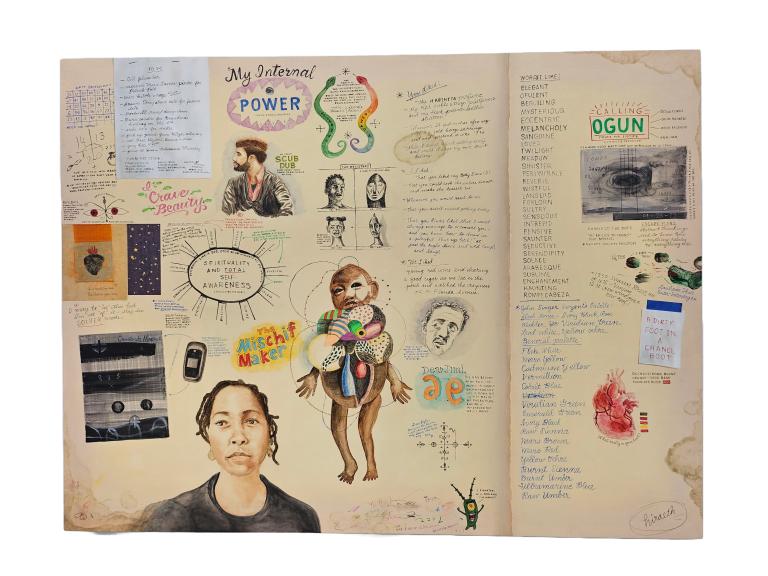
Exhibit Name: Draw Them In, Paint Them Out: Trenton Doyle Hancock Confronts Philip Guston
Location: The Jewish Museum
Willa Pelschoen is a sophomore at Bennington College in Vermont, who interned with Seeds for six weeks. One of her responsibilities was to visit multicultural exhibitions around the city and review them. We thank Willa for all her hard work!
Can cartoons give us a new perspective on the KKK? What if the KKK had faced a superhero named Torpedo Boy? Should we all start wearing bright yellow supersuits?
Trenton Doyle Hancock’s exhibition Draw Them In, Paint Them Out, asks all of these questions and more, while inviting us to explore the political nuances of art and expression in postmodern society.
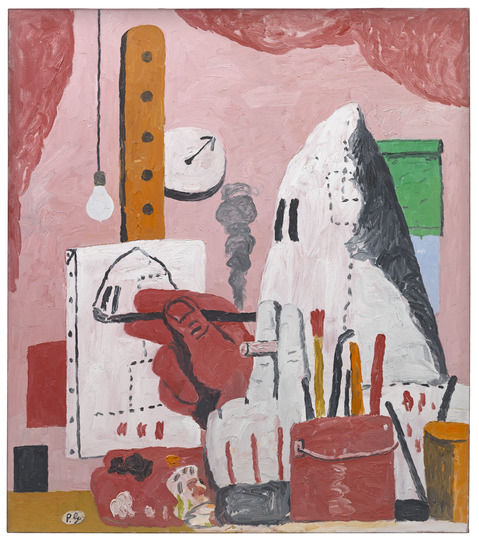
This controversial exhibit can be found at The Jewish Museum until March 30th, 2025, where Hancock’s cartoon paintings of KKK members and his character creation, Black superhero “Torpedo Boy,” square off. On the walls beside Hancock’s pieces, are paintings by Philip Guston (1913-1980), another Jewish artist who similarly depicted Klan members in a cartoon style, and who Hancock drew inspiration from for this collection. Hancock’s paintings showcase his artistic style and talent by telling the story of Torpedo Boy’s interactions with, and eventual destruction of Hancock’s Klan members, which look eerily similar to Guston’s. Hancock’s intentional use of color, words, and physical media such as plastic bottle caps throughout his pieces successfully differentiates from Guston’s work while quietly tying each detail back to the conversation he has created between the two collections of art, building on Guston’s idea to create a narrative which is more applicable to modern day.
The controversy of this exhibition comes from a decision made five years ago by four museums to postpone a traveling retrospective of Philip Guston’s artwork for fear that his cartoonish depictions of KKK members would be taken badly by the public. The Black Lives Matter movement was at its peak media coverage, and some of the largest artistic institutions in America, who were scheduled to show Guston’s pieces, suddenly felt it would be too great a risk to showcase artwork containing symbols of the KKK without any clear criticism of the group within the art. The irony and criticism could only be made clear with knowledge of Guston’s Jewish heritage and young adulthood, where he experienced the atrocities of the KKK’s political power over his community in Orange County, California, which the average exhibit viewer couldn’t grasp from simply viewing Guston’s art.
Now, 5 years later, Trenton Doyle Hancock, a Black artist from Paris, Texas is offering viewers a new perspective on the hostile imagery within Guston’s art, and he’s putting a young, Black superhero named Torpedo Boy at the center of it. On the walls of The Jewish Museum sit Guston’s pieces containing his iconic cartoon Klan members, wearing Mickey Mouse style red gloves, their robes covered in blood, while just to the side, Hancock’s paintings showcase those same Klansmen, only this time they are faced with a determined looking Torpedo Boy in a bright yellow supersuit, ready to create a new narrative, both on canvas and in life.
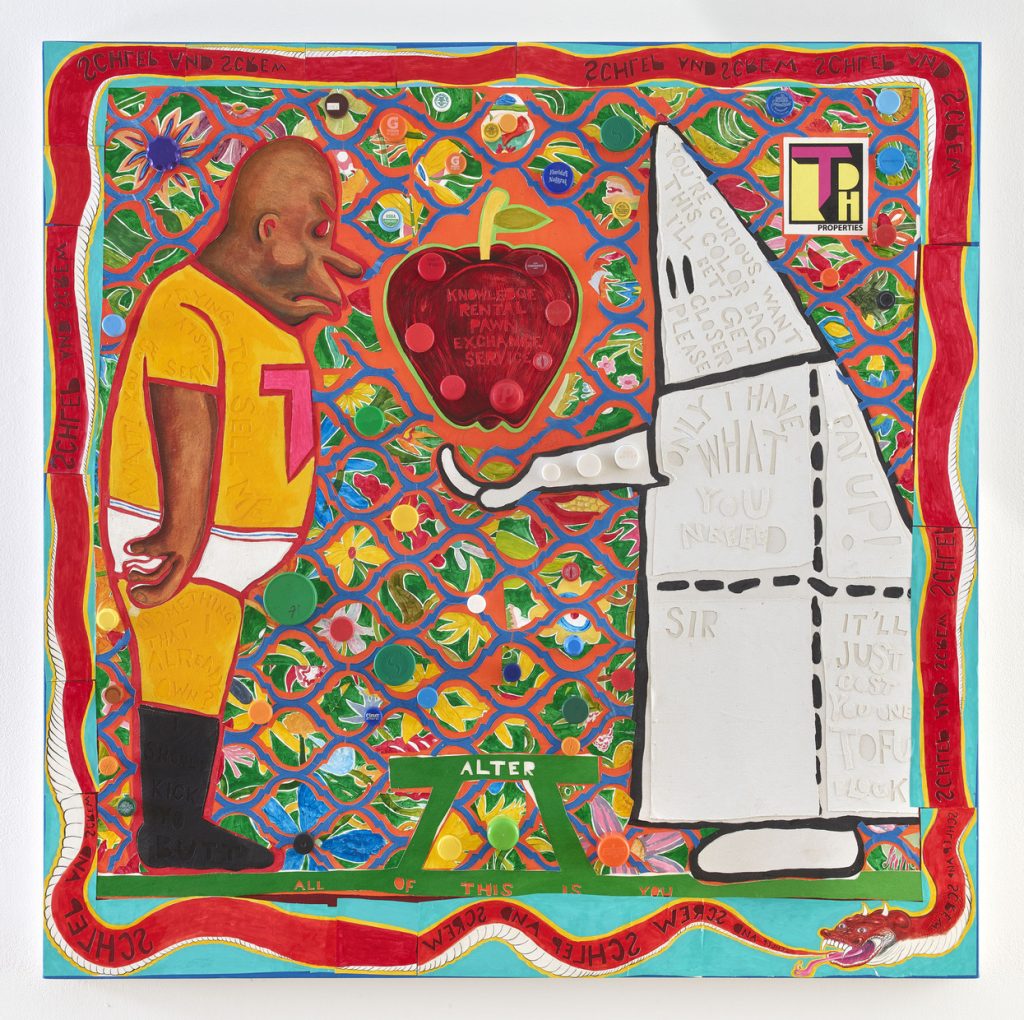
Left: Trenton Doyle Hancock, Schlep and Screw, Knowledge Rental Pawn Exchange Service, 2017, acrylic and mixed media on canvas, 60 x 60 x 6 in. (152.4 x 152.4 x 15.2 cm). Collection of Hedy Fischer and Randy Shull, Asheville, North Carolina
Right: Philip Guston, The Studio, 1969, oil on canvas, 48 x 42 in. (121.9 x 106.7 cm). Metropolitan Museum of Art, New York, promised gift of Musa Guston Mayer © The Estate of Philip Guston