Persisting Light: A Look at Ching Ho Cheng
Written by Oceana Andries
Oceana Andries is a writer and artist whose work explores the intersection of creativity and community, with a focus on amplifying underrepresented narratives and fostering cross-cultural dialogue. You can read more of her work @ocea.an on Instagram, and The Creative & Commercial on Substack.
The Art Students League is well known for the famous, influential artists who have taught there and attended classes. Seeds is introducing a series of articles about lesser-known artists who have attended the League, with a focus on those whose ethnic, racial, gender, or other identity made them minorities within the American art scene.
As I searched for a lesser-known League artist to feature in this edition, I looked through the League’s records and searched online until I found Ching Ho Cheng (1946-89). Among the images of his work, the painting titled The Peach (1978) completely entranced me, and as I dived deeper into his story, I knew I had to share it with you all.
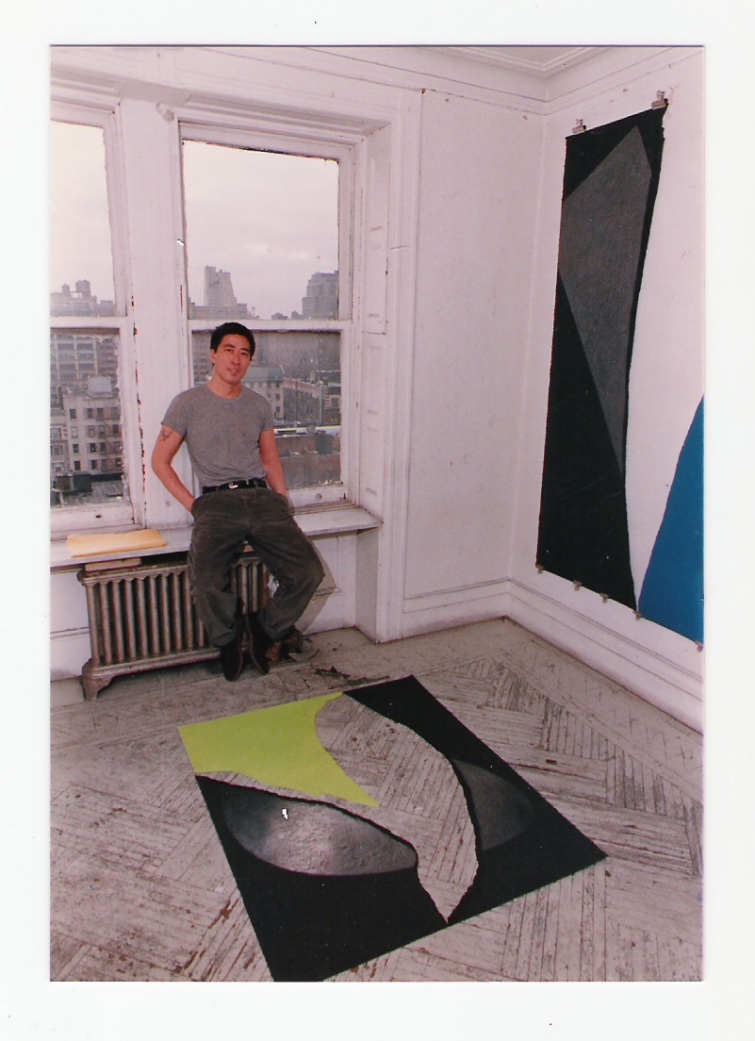
Ching Ho Cheng was a queer artist whose life and work were marked by social and political turmoil. He was born in Cuba, where his father was a diplomat and his mother a fashion designer. They turned to the U.S. after the Chinese Revolution. He, his parents, and his sister were admitted to the United States in 1950, when Cheng was 4, under the Chinese Exclusion Repeal Act of 1943. That year, the act allowed 105 Chinese people to immigrate. (The act reversed the Chinese Exclusion Act of 1882, which prohibited all immigration of Chinese laborers for 10 years and denied Chinese residents the right to become citizens, among other discriminatory practices.) Though the Exclusion Repeal Act was a step in mending foreign ties, its limitation on immigration meant Cheng became a part of a very small group of Chinese American artists in his generation.
Cheng found himself in the center of a bustling art scene and a postwar landscape during the HIV/AIDS crisis. According to a biographical sketch, he started studying during summers at the Art Students League of New York.1 In the summer of 1964, he registered with League instructor Raymond Breinin, himself an immigrant in 1909 from Vitebsk, Russia (now Belarus), a Works Progress Administration (WPA) artist and painter with slightly surreal or mystical tendencies.2 Cheng enrolled in Cooper Union in the fall and graduated in 1968. His practice is deeply influenced by Taoism, an ancient Chinese religion that teaches following the natural flow of the universe, called Tao, and by Egyptian mythology. These influences show up in the work through the recurring themes of spiritual renewal and alchemical change
© 2026 ESTATE OF CHING HO CHENG – Artists Rights Society (ARS) New York
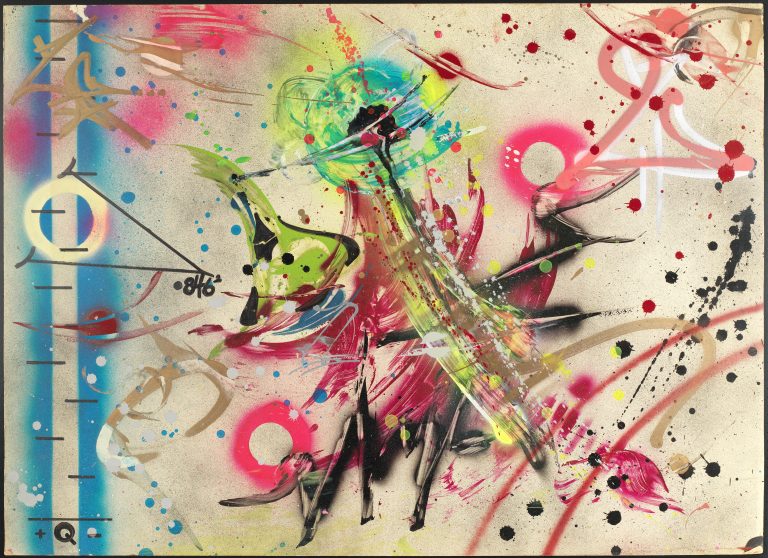
In his short life, Cheng developed four main bodies of work: Psychedelic Series, Gouache Works, Torn Works, and Alchemical Works. Within these series and throughout his work, a common thread is the exploration of light. I’ll be exploring his Psychedelic Series and Gouache Works.
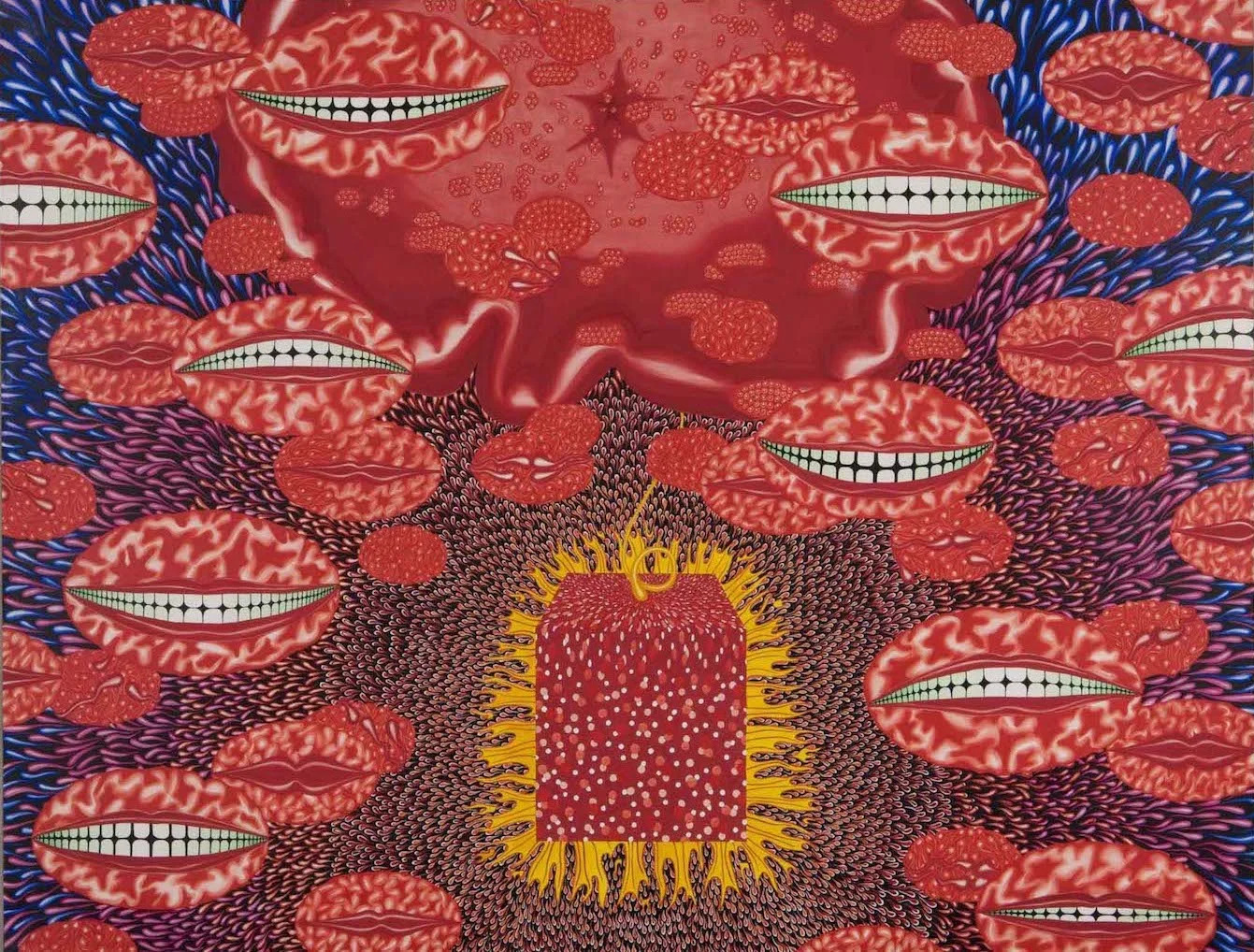
The Psychedelic Series was created after Cheng graduated from Cooper Union. The series’ namesake encapsulates the work’s stylistic qualities. The subject matter is metaphysical and is rendered with kaleidoscopic qualities in bright colors. There’s a maximalist approach to covering the surface, with no area left untouched. Tibetan spiritual practices heavily inspire the series’ imagery. The work above, Angel Head (1971), showcases a red cube speckled with varying tones of white and red. Emerging from its top is a yellow cord that connects to a red mass in the work’s upper center. The cord symbolizes a tether between the physical body and the spiritual plane. The work is energetic and full of activity, from the movement in the background to the creatures with mouths; it is vibrant and methodically created. Through its portrayal of movement with shapes similar to small tentacles, the piece is ever-expanding. The yellow light emitted by the cube creates an energy field, and all the other elements in the work seem to move outward from it. The works in this series share the sense of movement through their portrayal of energy. Its maximalist qualities showcase Cheng’s spiritual quest to portray a connection between the physical body and the metaphysical plane through a psychedelic approach.
© 2026 ESTATE OF CHING HO CHENG – Artists Rights Society (ARS) New York
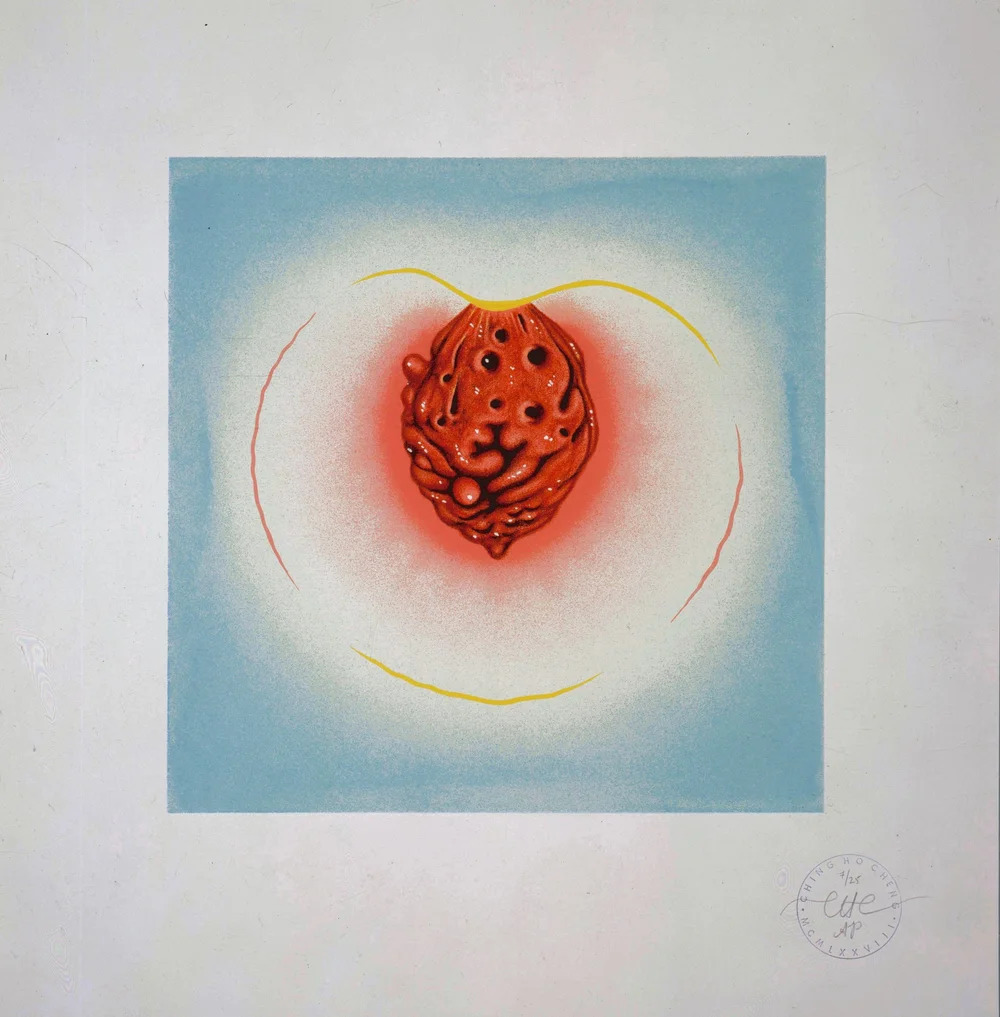
The Gouache Series is quite a departure from his psychedelic work. The series focuses on restraint and pulls back from the maximalist qualities of The Psychedelic Series. There’s a meditative intentionality in the visual language of this series. The elements within the works are visually minimal (with a focus on silhouettes and, once again, light), so the works feel more spacious and tranquil. The Peach (1981) is the work that first caught my attention. The use of a peach’s silhouette, combined with the pit beautifully rendered in the center, creates a striking contrast. A soft glow is emanating from the work’s center; it draws our eyes to the peach pit. The subjects of this series have spiritual meaning. The peach is a Chinese emblem of longevity. Since the pit, a seed, is the most detailed element, it emphasizes its meaning of longevity, as a future peach will grow from this seed.
© 2026 ESTATE OF CHING HO CHENG – Artists Rights Society (ARS) New York
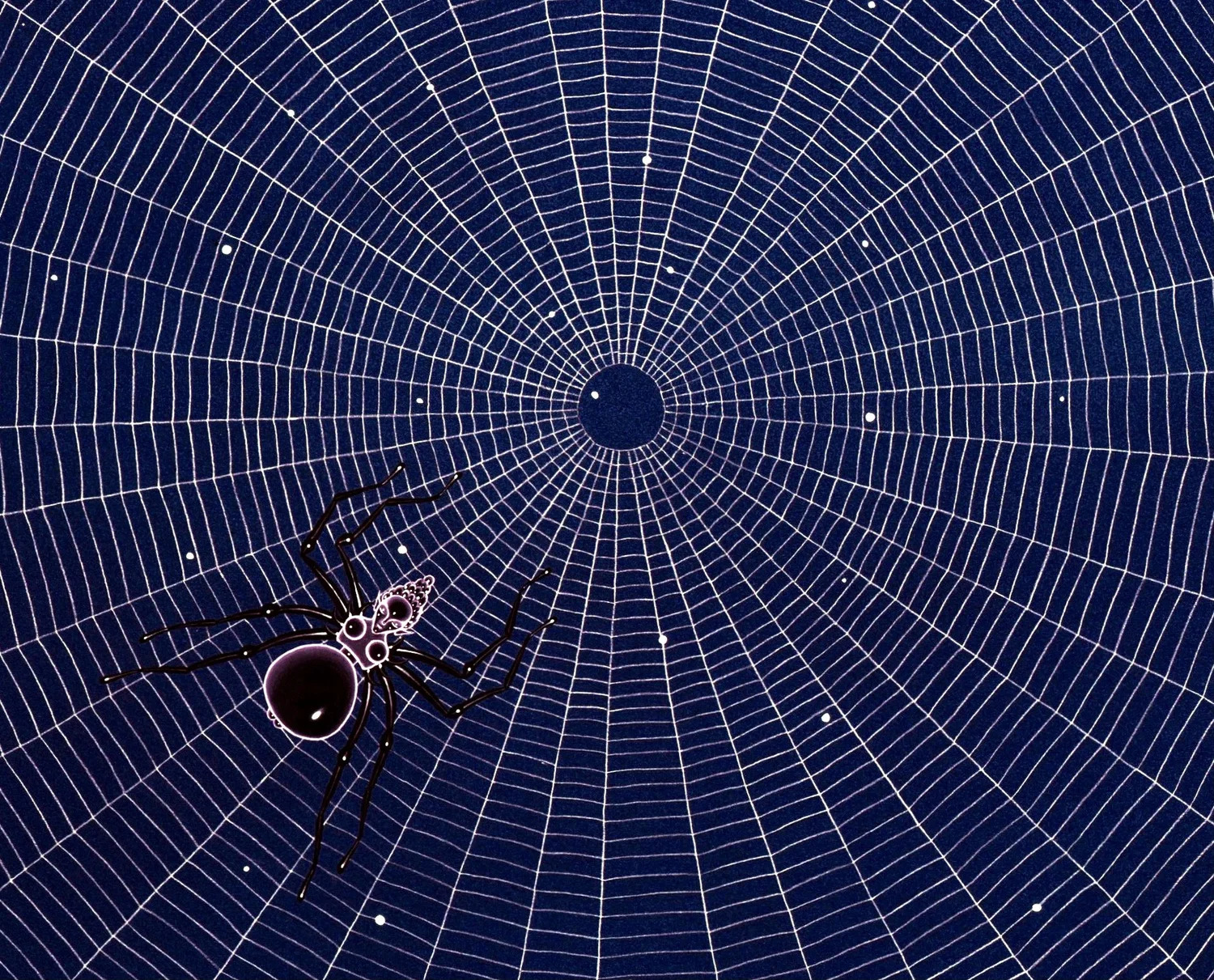
Within Miss Destiny (1979), another work in the Gouache series, a spider’s web is illuminated, and the spider rests not too far from its center. The title of the work, Miss Destiny, refers to the anthropomorphic spider, which appears celestial in its construction. If you look closely at the spider, you’ll notice its upper body is composed of a woman’s torso and head attached to a spider’s abdomen. Its hair is similar to that of a Buddha’s, which reinforces the spiritual themes in Cheng’s work. The work’s background is a starry night sky rendered in a rich blue, while the intricatelycreated white web in the foreground creates a play between light and dark. The spider faces the center of the web, guiding viewers into a circular space that offers an unfiltered view of the night sky. As Miss Destiny rests, seemingly admiring her composed web, questions arise about the composition of fate and intelligent design in the universe.
Luckily, Cheng’s work and these themes will be on display in two upcoming exhibitions. At The Grey Art Museum (New York University’s fine arts museum) and the Addison Gallery of American Art, both in 2027. These exhibitions aim to give Cheng the recognition his work deserves. Addison Gallery of American Art will present the full scope of his work, which hasn’t been seen in its entirety since his passing, in the exhibition titled The Light Will Continue. Named after this quote from the artist:
“I want to capture something of the miraculous. Light is the most awesome symbol of the Order of the Universe. Nothing can beat the speed of light. When I paint light, I’m not just concerned with the phenomenon of light. I am trying to depict the illumination. The light will continue. It is eternal. A light bulb will die but there will always be light. A match will die but there are stars and new stars to be born.”
Cheng died on May 25, 1989. According to a New York Times article published on June 2, 1989, Gert Schiff, an art historian and long-term companion to the artist, said the cause of death was chronic lung disease caused by working with toxic materials like iron and copper dust. These materials are found in his final series, Alchemical Works. Later press revealed Cheng’s cause of death to be from HIV/AIDS-related complications. We can assume that the stigmas attached to queer communities resulted in the cause of his death being originally obscured. Though Cheng’s life was tragically short, he created a robust body of work that continues to inspire the arts today; his artistry became a light that persists.
1 For more on Cheng, visit https://www.chinghocheng.com/
2 For more on Raymond Breinen, visit https://murals.info-ren.org/artist_info.php?artist=Raymond+Breinin