Loving the Process
Interview with Liz Almonte
By Mei Bock
The first time I met Liz, she was leading a class of elementary school students at PS37 through a painting lesson. With the class divided into Spanish and English speakers, she seamlessly glided between the two languages to prompt students on color mixing and paint application. Liz has been a Seeds of the League Teaching Artist for two years, teaching art classes in public schools and community centers. They hold a BFA in Studio Art from NYU. I spoke to Liz about their teaching, art practice, and work as a curator for Lavanda.
Mei: Walk me through what your journey with art has been. You went to HSAD, then to NYU, and you’re still doing art. Were you an art kid?
Liz: I was. My first portrait was a big circle, and I’d build the bodies like centipedes. I would make little boxes as the body with sticks. I went to High School of Art and Design for Illustration. I was taught by Mr. Harrington for all three years, so that’s how I know about the Art Students League.
Mei: The pipeline.
Liz: He is the pipeline. I don’t know if he still does this, but he would do morning club before school starts, with a model sitting, and we would all paint. I was in charge of helping to find the models for that. He’s the one that taught me how to oil paint. Since then, I love oil paint. I thought I would go to a state school, but then I got a scholarship for NYU, for a BFA in Studio Art. I did a minor in Business, Entertainment, and Media technologies—-a mouthful. You get to pick and choose what track you want. I learned about the music industry, entertainment industry and more administrative stuff that I wouldn’t normally get through my studio art track.
[sketchbook or image of Liz teaching here]
Mei: You get to be a jack of all trades.
Liz: Yes, I love learning new things. I like having my hands in many different buckets, even though I only have two hands. I started as an illustrator, and then I focused a lot on painting for a good chunk of my art practice. And recently I fell in love with the process of photography. I’m looking into the process of cyanotyping. On a previous project, I figured out how I could treat fabrics, print it directly on it with an inkjet printer. The way I approach my work is very heavy on process because I always want to try something a little bit different.
Mei: When did you start teaching art?
Liz: During the pandemic, I got an email from Denise, through Mr. Harrington. I taught a one-time workshop of nature sketching on Randall’s Island. Because it was the pandemic I only had one student, an older woman. It was just me and her talking. I started teaching her about drawing from observation, going from generic to specific, and shadows. I got my toes in the water about teaching another person.
Mei: Do you learn from how you teach?
Liz: For many of these kids, it’s their first time making art or even thinking about seeing. I’ve learned time and time again that even though I have a lesson plan in my head and I have a process of how I want the children to approach it, there’s always going to be that one kid who does it in a way I didn’t anticipate. It can be as simple as “I want you to draw a circle.” You assume they’re going to draw a circle in the center, but they’ll draw it in the corner, small, big, or teeny tiny. It’s a good way to think of things outside the box of my own practice.
Mei: I was interested in the rabbit motif in your work. There are some realistic rabbits, and a recurring, cartoon rabbit. Is that a character?
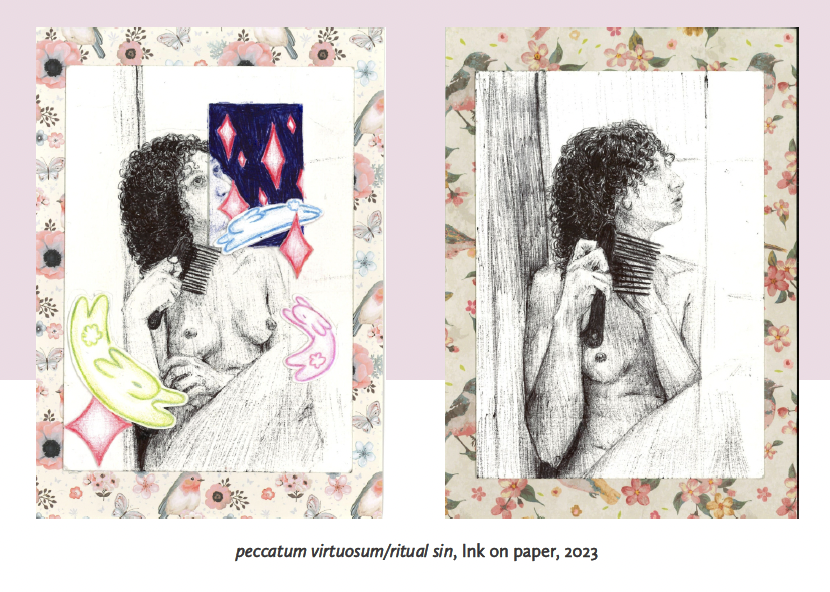
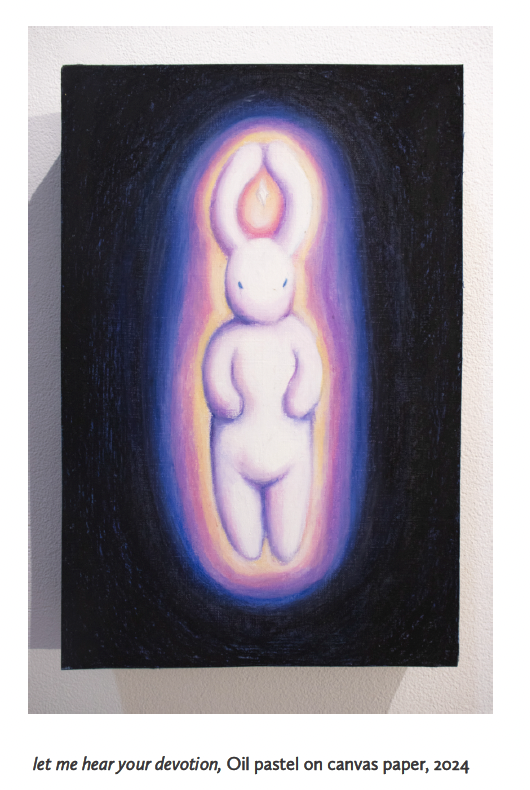
Liz: I really enjoy the symbol of the rabbit because it has many different meanings in varying cultures. In Western, or Eurocentric culture, it is about purity, virginity, virtue. In others, the rabbit is seen as cunning, or a symbol of sex or fertility. I enjoy that juxtaposition between those motifs. I made “let me hear your devotion” in relation to a show called Monomania. Our theme was obsession and compulsions. I’m obsessed with rabbits. I also made ballpoint pen drawings, which are these close-ups of my partner’s body, to say “hey, these are devoted to you, even though it’s a little bit compulsive.” Like devotional objects.
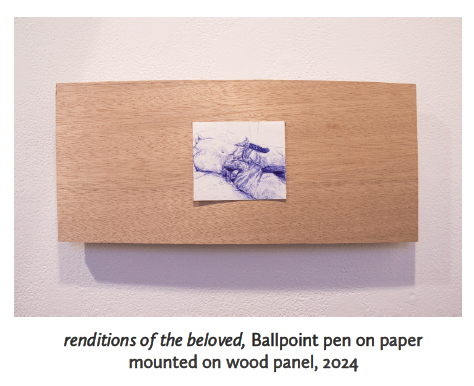
Mei: Your work has a vignette quality that makes the subjects warm and makes you feel so close to them. There’s two ways I see you doing this: first, in small scale of the works. Even in how you present them, you’reemphasizing the smallness, like with the ballpoint drawings mounted on wood. Are you thinking about scale when you conceptualize the piece?
Liz: I think it sort of just happens. I fall back onto a smaller scale because it’s very portable. In my college career, I was a commuter student. I always had to think how to transport the piece back and forth. I also tend to draw a lot on the train.
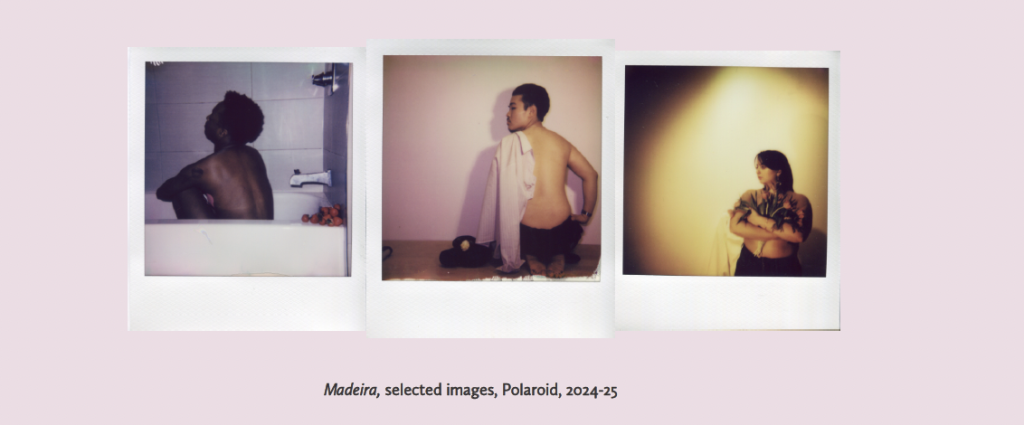
Mei: You also utilize a smaller scale in “Madeira.’
Liz: “Madeira” is a big project I did with my partner. It was a series of photo shoots of nine different subjects based on motifs related to their personalities. We had an orchid, strawberries, hydrangeas, representing queer artists and their bodies. The idea first came about because my partner was inspired by Andy Warhol’s Polaroids. Then we were looking at a photograph by Peter Hujar, “Candy Darling on Her Death Bed”. We were thinking about earlier contemporary queer work and how it has the tendency to surround death because of the historical context of the AIDS epidemic. Now, we are able to celebrate life and the mundane, the domestic within a queer sphere. This project is a foil of the trope that to represent queer bodies, it has to be under a morbid context.
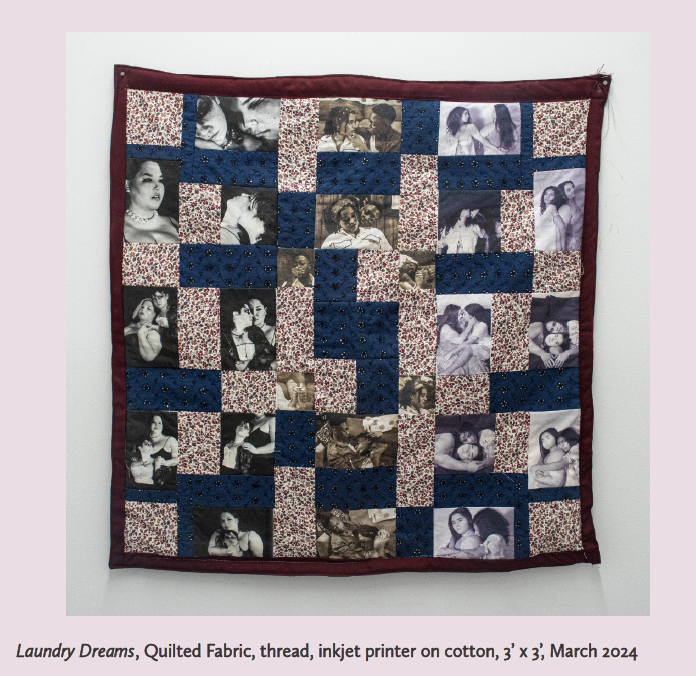
Mei: Tell me more about “laundry daydreams.”
Liz: That project took me three months and I had to remake it at one point. First, it was a photo shoot with all the different sets of models. It was a team effort and I embroidered everyone’s name who was involved on the back. It was my first time making a quilt so I had no idea what I was doing. I remade it because in the first prototype the images were a little too faded. I reprinted everything, changed some of the fabric, embroidered everything on the back, accidentally misspelled my friend’s name, and re-embroidered it. My poor sewing machine stopped working for a bit because one of the screws fell in.
Mei: This is part of what you were talking about earlier with process. Does it stress you out?
Liz: It’s a love of labor and a labor of love. I wouldn’t be doing this if I didn’t like it.
Mei: What is Lavanda and Pansy Debutantes?
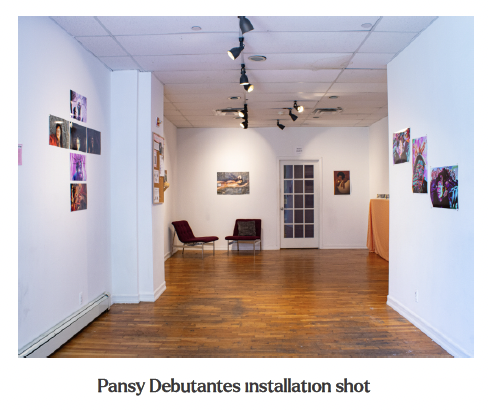
Liz: Lavanda Collective was started by two of my friends, Nico and Brooke, who both went to NYU. They wanted to make a space where people can just create and essentially have a horizontal structure. You come with a project and there’s people who are there to work as an extra set of hands. If you don’t have the models for your project, there’s a set of people who can help. Or, if there’s a skill gap on the project, Lavanda can help fill it. Pansy Debutantes is our debut exhibition, to introduce the world to what Lavanda is and what we’re trying to do, and essentially be enthralled and entwined with the community, and be a safe space for creatives and other queer people to just share.
Mei: How did you go about curating the exhibition?
Liz: Niko came to me and told me about potentially doing a show in the gallery space of Brick Aux, where he works. Niko is a performing artist and a writer so he doesn’t really know how to do gallery stuff like me. That’s my bread and butter. Years at NYU Barney have prepped me for this moment! We need a press release, an art checklist, an artist statement, work samples so I can figure out a theme, we also need a title. All we knew is we wanted to represent Lavanda and what Lavanda means for the community. We had a couple of meetings, workshopping, and installation. We also took the opportunity to raise funds, so our communications team reached out to a couple of queer-friendly brands so we could sell their products.
Mei: How do you tap into all the art opportunities that NYC has to offer?
Liz: You never know who’s going to turn around and be like, hey, I want you to work on this with me. A lot of people I work with are people I befriended. I work with my partner. It’s interesting seeing how interconnected the community is. It’s very small, so it’s important how you carry yourself and how you treat others, because you never know who’s going to want to work with you.